
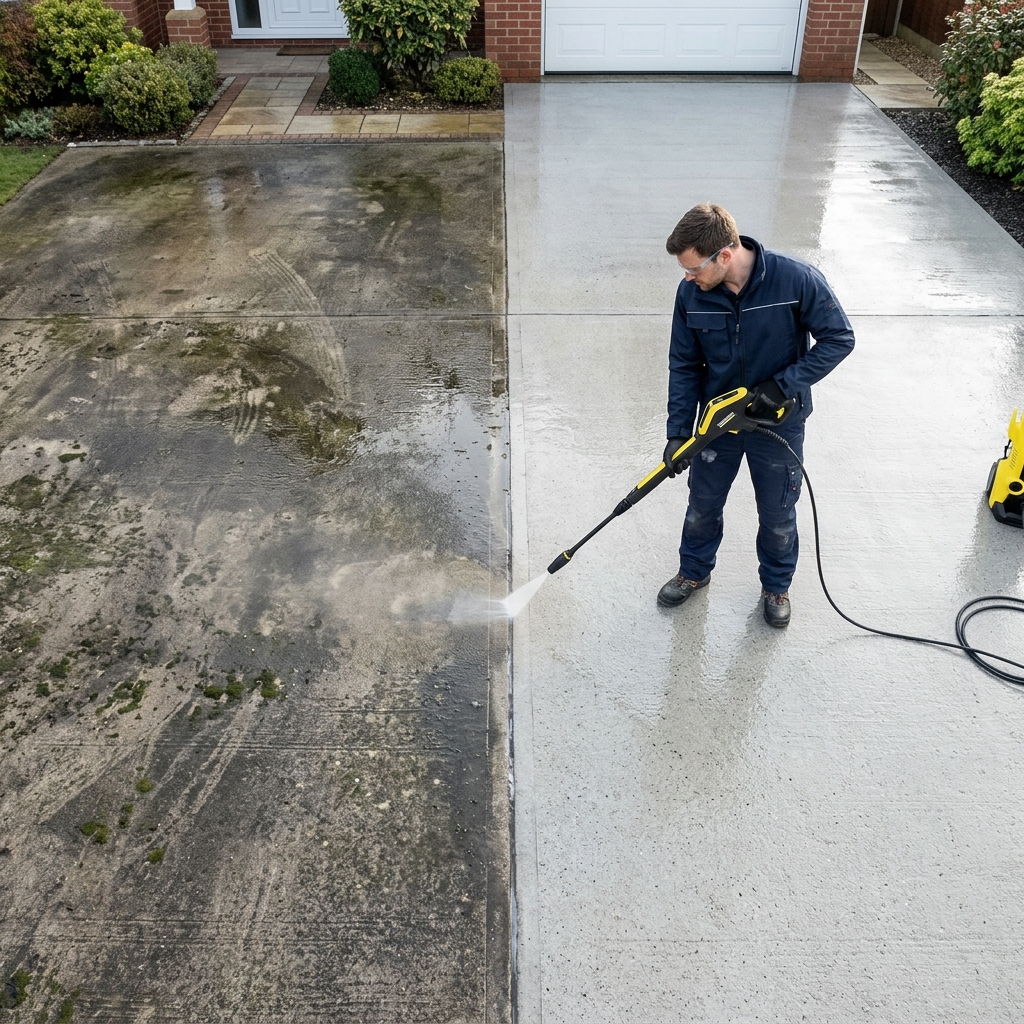
It's the question we get asked on almost every quote call: "Is this going to damage my driveway?" or "Won't that crack my roof tiles?" Fair questions — a lot of homeowners have seen a bad DIY job, or a story online, where high-pressure water stripped concrete or cracked tiles. The truth is, pressure washing itself isn't the problem. Wrong pressure, wrong nozzle, and wrong technique are.
The real answer: it depends on the surface and the operator
Every surface has a safe pressure range. Concrete driveways can generally handle higher pressure (2,000–3,000 PSI) because they're dense and durable. Roof tiles, especially older concrete or terracotta tiles, are far more fragile and need a completely different approach — often a soft wash using lower pressure and a cleaning solution, rather than a direct high-pressure blast.
Where DIY pressure washing goes wrong
- Wrong nozzle angle — a narrow "pencil jet" nozzle held too close can etch grooves into concrete or crack tile glazing in seconds.
- Too much pressure for the surface — hire-store machines often run higher PSI than needed, with no way to fine-tune it for a delicate surface.
- No test patch — professionals always test an inconspicuous area first; most DIY jobs skip this entirely.
- Working roof tiles at the wrong angle — spraying up under overlapping tiles can force water beneath the roofing membrane instead of cleaning the surface.
What we actually do differently
For driveways, paths, and concrete surfaces, we use calibrated commercial pressure washers set to the correct PSI for the specific material, with a fan-tip nozzle held at a safe distance — enough to lift oil stains, tyre marks, and grime without etching the surface.
For roofs, we almost always recommend a soft wash: a lower-pressure application combined with a cleaning solution that breaks down moss, lichen, and algae at the root, then rinses it away gently. This is both safer for the tiles and more effective long-term, since it doesn't just blast away visible growth — it treats the organic matter causing it.
So is it safe?
Done correctly, yes — pressure washing (or soft washing, where appropriate) is one of the safest and most effective ways to restore concrete, roofs, and exterior surfaces. The damage stories you've heard almost always trace back to the wrong equipment, the wrong pressure setting, or someone rushing the job without testing first.
If you're ever unsure whether a surface on your property is suitable for pressure washing, ask us before you book — we'll tell you honestly, even if that means recommending a gentler method instead.
Get it cleaned the safe way
We calibrate pressure and technique to your specific surface — driveway, roof, or exterior wall. Free quotes across Melbourne.
Get a Free Quote